By Alexandre Moniz Barbosa
How does one link football to the fado? Easy, you have to be Portuguese and mourning the country’s performance from the 2026 FIFA World Cup, right from the draw in the opener with DR Congo that Portugal was expected to win and then its exit following the loss to traditional rival Spain. For the Portuguese, that first draw felt like a loss and Portugal Decoded, an internet portal titled its piece on the match thus: ‘No wonder Fado is about suffering’ and then said, ‘Forget football. Suffering is the true national sport… But it’s not over yet.’
But back to Portugal. A few years ago, BBC had called Portugal as ‘the European country that loves being sad’ and amplified it saying: ‘If you ask a Portuguese person how they’re doing, the most enthusiastic reply you can expect is mais ou menos (so so).’
And how did Portugal do in the World Cup? To the rest of the world the answer could well be mais ou menos but if you’re Portuguese, then, as one of them told me, ‘foi uma desilusão’ (it was disillusionment). Sadder still for them than otherwise, one would guess. The media too was not complimentary. After that first draw, Publico in a picture on its front page said: ‘Mau resultado, péssima exibição’ (Poor result, terrible performance), while Diario de Noticias said, ‘Empate com sabor a derota’ (Draw with the taste of defeat).
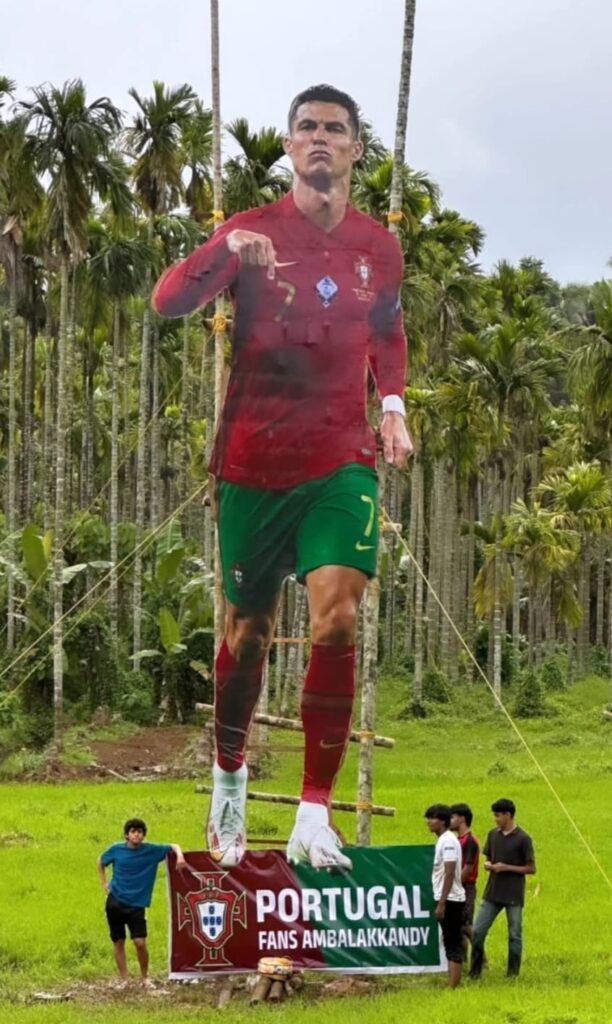
Giant Cristiano Ronaldo statue in the landscape of the Indian state of Kerala built by the Tourism Department
But, as Portugal Decoded had said, it wasn’t over for Portugal and the Selecção hammered Uzbekistan in the next match scoring four times, Cristiano Ronaldo booting two of them. Publico, again with a picture on their front page said: ‘Portugal afasta depressao com goleada e “bis” de Ronaldo’ (Portugal shakes off slump with rout and Ronaldo brace), while Expresso said, ‘“Shiu!”, gritou Ronaldo no Mundial, onde Portugal mandou calar as cigarras’ (Shiu! Ronaldo shouted at the World Cup, where Portugal silenced the cicadas). CR7 was back at doing what he does best for Portugal—scoring goals. But it was not to last for long.
When Portugal lost to Spain in the Round of 16, its media was far more generous to the Selecção, but not all of the media. A comment on Publico said, ‘Portugal adormeceu na siesta e vai ver o resto do Munidal em casa’ (Portugal dozed off during the siesta and will be watching the rest of the World Cup from home). Perhaps, one of the most telling comments came from SIC Noticias, that is a post on social media wrote: ‘Desta vez não houve padeira que nos salvasse. Portugal elimindao do Munidal pela Espanha’ (This time, there was no bakerwoman to save us. Portugal eliminated from the World Cup by Spain). This is a clear reference to the Brites de Almeida, Portugal’s celebrated baker, who in 1385 at the battle of Aljubarrota killed seven Castilian soldiers in a war that Portugal won.
For a country that was aiming, or should we now say hoping, to fly back home with the trophy, the football they played was definitely not the best.
That first day and one point felt like a defeat and their star player was even dubbed a statue. For that matter, the international media has been far from complimentary to Cristiano Ronaldo, who at 41 played his sixth World Cup. His performance on the field was far from the best the world has seen from Ronaldo and there were calls that he should not be played. But could he be benched?
If he were to be dropped, what about his fans across the world? As one Goan-Portuguese who travelled to USA and attended two of the Portugal matches, messaged me from the stadium, ‘There are more Ronaldo fans than Portuguese fans’. True, if there was support for Portugal this World Cup, then it was solely because the CR7 fan brigade has put its might behind the team he plays for—Portugal.
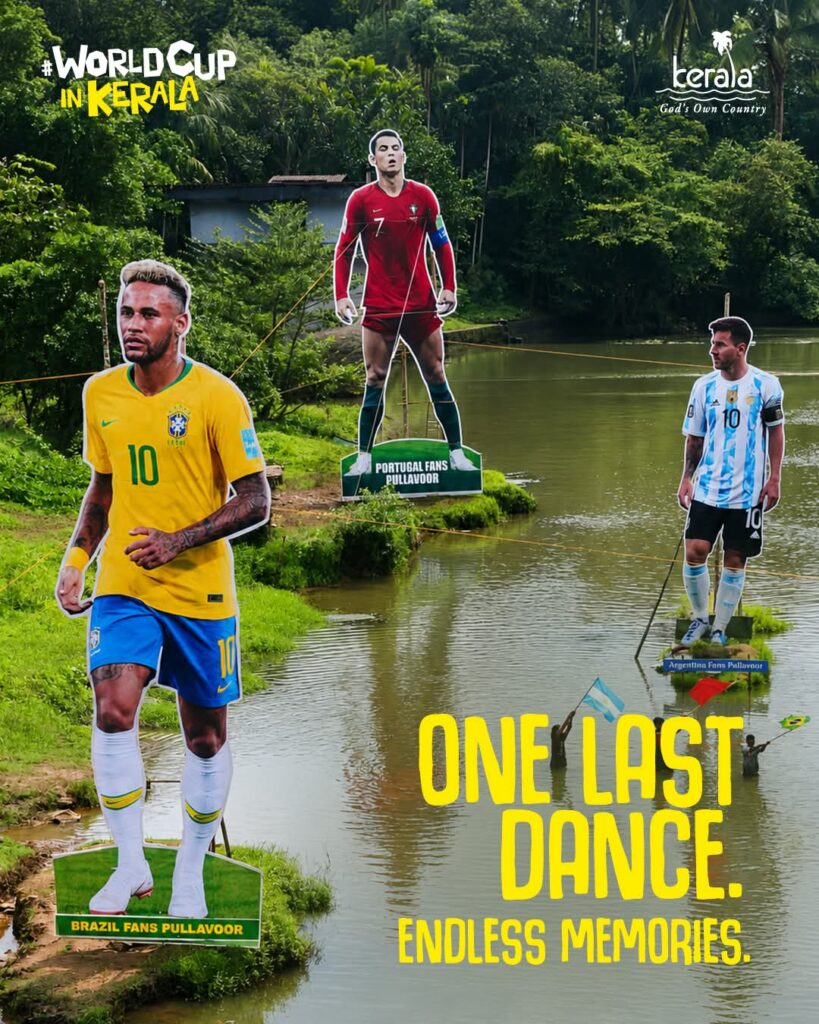
Cristiano Ronaldo, Messi, and Neymar in the landscape of the Indian state of Kerala
Nothing new here, for four years ago in Qatar, it was the same story. Portugal had legions of supporters all because of Ronaldo, and they had spread even in India. One has to only look at some social media pages, especially of football fans in the state of Kerala, which are replete with photos and reels of Ronaldo, showing cutouts of CR7 that are taller than three-storied buildings, or roadside artworks that are 200 feet long or more. One particular page on Facebook, Portugal Family Kerala, has three hundred thousand members, that’s more than half the population of Cabo Verde, another former Portuguese colony that made waves at the World Cup.
Well, FIFA 2026 is over for Portugal, but it has 2030 to look forward to, when it will host the World Cup along with Spain and Morrocco. But that’s for four years from now. Right now, Portugal will have to regroup without their star player and maybe for once in 2030 the fado may not be all about suffering. That, however, will depend on how far the country reaches in that World Cup.
While the teams fight it out on the field, for the rest of us who have been sleeping late and waking up early to catch the action, the World Cup is not always counted by points but by goals, and so far there have been plenty of those. Nobody’s complaining on that count, but certainly, many reading this will possibly be grumbling at Portugal’s exit or, who knows, they could be singing a mournful fado.
Alexandre Moniz Barbosa
Alexandre Moniz Barbosa is a journalist/writer/editor based in Goa, India. He was executive editor of the newspaper “O Heraldo” and resident editor of “The Times of India” and of the magazine “Goa Today”. He has published several books and was the winner of the 2013 biennial Goan Short Story contest. His latest book, Colonial Sunset, is set against the backdrop of the liberation of Goa.